27. 7. 2026


A recent article in the prestigious Nature Communications journal uncovers a new mechanism of the rare Kleefstra syndrome. Bridging multiple expertises, the research involved Alan Kadek from IMIC’s Laboratory of structural biology and cell signaling, who further collaborates with the lead author Ales Hnizda from Charles University in a new joint Czech Science Foundation grant project.
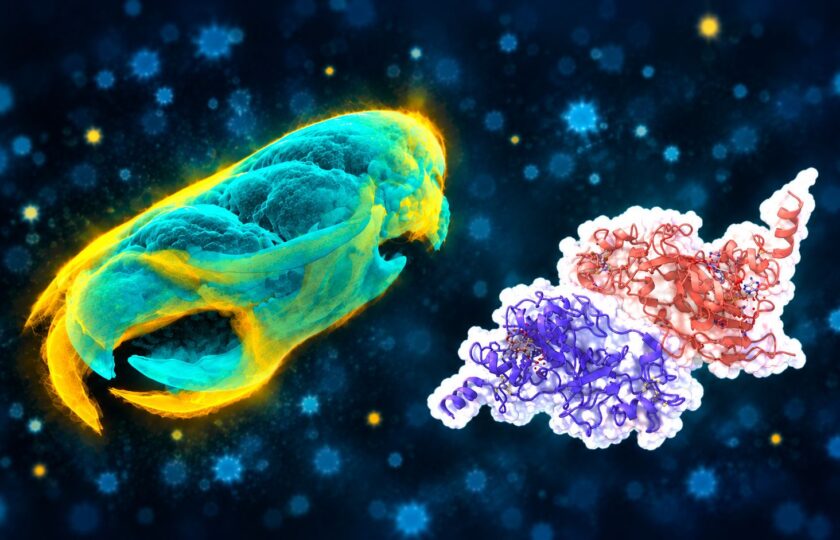
Researchers from the Institute of Microbiology of the Czech Academy of Sciences (IMIC CAS), in collaboration with colleagues from the First Faculty of Medicine at Charles University, the Czech Centre for Phenogenomics (CCP), the National Centre for Medical Genomics (NCMG), the Institute of Molecular Genetics of the Czech Academy of Sciences, Ostrava University Hospital, and partner institutions abroad, have elucidated the mechanism of a rare neurodevelopmental disorder associated with de novo mutations in the EHMT2 gene. The study, published in the journal Nature Communications, integrates clinical observations of patients with manifestations of Kleefstra syndrome, genomic diagnostics, molecular and structural analyses, and experimental validation in a genetically modified mouse model.
Kleefstra syndrome is a rare neurodevelopmental disorder caused by mutations in the EHMT1 gene. It is characterized by developmental delay, speech and learning difficulties, and reduced muscle tone. Some patients may also exhibit characteristic facial features, congenital heart defects, and behavioural or sleep disorders. The new study demonstrates that a clinically similar disorder can be caused not only by mutations in the EHMT1 gene but also by specific variants of the EHMT2 gene; therefore, an accurate genetic diagnosis can help better explain the cause of the symptoms and guide appropriate long-term care.
As part of the BIOCEV research centre, in close collaboration with the team of Prof. Stanislav Kmoch from the First Faculty of Medicine at Charles University in Prague, IMIC researchers used native mass spectrometry to characterize the molecular mechanism leading to the dysfunction or significantly reduced activity of the enzyme complex of the human proteins GLP and G9a, encoded by the EHMT1 and EHMT2 genes. Together, these two proteins participate in the regulation of the chemical modification of histones – the proteins around which DNA is organized within the cell. This so-called epigenetic modification – methylation – helps determine which genes are active in individual cells during development and which remain silenced.
When the function of the GLP-G9a complex is disrupted, genes may be turned on or off incorrectly during the organism’s development. This can have a profound impact on the development of the nervous system and lead to a neurodevelopmental disorder. The molecular mechanism revealed in the current study – involving mutations identified in the EHMT2 gene in a patient from Ostrava and subsequently in other patients worldwide – involves a disruption in the binding of a histone or S-adenosylmethionine – a small molecule that donates a methyl group – to the GLP-G9a complex. The effective binding of all these components of the epigenetic reaction and the formation of a molecular complex is necessary for the proper function and epigenetic regulation of other genes.
“So-called native mass spectrometry, which made it possible to monitor the formation of the complex and the binding of the reaction components, is an advanced structural-analytical technique that allows for highly accurate and sensitive determination of the molecular weight of even large, non-covalently bound protein complexes. Depending on the size of the complex, it can detect minute changes in mass at the level of individual atoms.” explains Dr. Alan Kádek from the Laboratory of Structural Biology and Cell Signaling at IMIC.
As the study’s first author, Dr. Aleš Hnízda from the First Faculty of Medicine further notes: “Thanks to native mass spectrometry, we were able to distinguish not only the interaction of individual components of the epigenetic reaction but we could also observe the binding of individual zinc ions, which are essential for the GLP-G9a enzyme. Furthermore, thanks to its mass precision, this technique uniquely allows us to distinguish in the spectra between various co-occurring forms of GLP and G9a complexes, which are very similar to one another.” This further led to a successful application for a follow-up grant from the Czech Science Foundation, which Alan Kádek and Aleš Hnízda, together with their teams, have been working on since early 2026 and in which they further study the GLP-G9a complexes.
PUBLICATION
„De novo EHMT2 variants cause an autosomal dominant EHMT2-related Kleefstra syndrome via loss of G9a methyltransferase activity“, Nature Communications, 2026. PubMed: PMID 42386776.
DETAILED PRESS RELEASE FROM 1. LF UK (in Czech)
Please be advised that the IMIC CAS is changing its email addresses.
The new email address follows this format: “”
The original “@biomed.cas.cz” address on the website will be updated shortly.