25. 6. 2026


Taťána Gazárková is currently a postdoctoral fellow in the Laboratory of Antibiotic Resistance and Microbial Metabolomics. During her doctoral studies, she focused on chromatography and mass spectrometry. Recently, she was awarded second place in the “Sanofi Prize for Pharmacy 2026” competition.
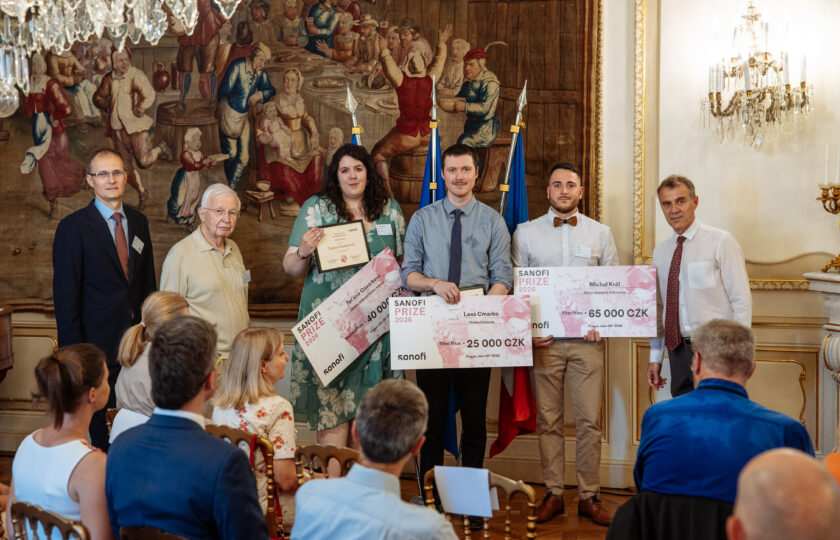
Taťána Gazárková is currently a postdoctoral fellow in the Laboratory of Antibiotic Resistance and Microbial Metabolomics. During her doctoral studies, she focused on chromatography and mass spectrometry. Recently, she was awarded second place in the “Sanofi Prize for Pharmacy 2026” competition, which is awarded by the French Embassy in the Czech Republic for her dissertation – Steroid Analysis Using Modern Chromatographic and Mass Spectrometry Techniques: From Fundamental Studies to Targeted Bioanalytical Applications (supervisor: Lucie Nováková, Charles University).
What makes this field particularly exciting or unique in your view?
What I enjoy about analytical chemistry is that, to a certain extent, it is a kind of detective work. You are often looking for ways to “make the invisible visible”. In other words, extract the information you are interested in from a complex sample and then interpret it correctly. What also appeals to me about bioanalytical chemistry is its interdisciplinary nature. It brings together analytical chemistry, biochemistry, biology and medicine, which means that you need to be able not only to translate a biological or clinical question into a measurable analytical experiment, but also to place the resulting data back into a broader biological context. This combination of different perspectives is probably what I enjoy most about the field. At the same time, there is still plenty of room for fundamental research, ranging from studying analytical techniques themselves and improving them to developing new methodological approaches.
How did you end up at the Laboratory of Antibiotic Resistance and Microbial Metabolomics, and what project are you currently working on?
I came to the Institute of Microbiology through a joint project between Dr Zdeněk Kameník and Assoc. Prof. Jan Bobek from the First Faculty of Medicine, Charles University. For me, it was also an opportunity to move from targeted analysis and the study of chromatographic techniques towards untargeted metabolomics and new biological questions.
In the project, we are trying to identify new biologically active compounds that would be effective, particularly against pathogenic fungi. As a potential source of such compounds, we study streptomycetes, bacteria known for their ability to produce a wide range of biologically active compounds, including many antibiotics that are currently in clinical use. We focus on less-explored host-associated streptomycetes, in which we had already observed antifungal activity in previous experiments. We are especially interested in strains active against Candida albicans whose activity cannot be explained by the presence of a known bioactive compound. These strains may represent an interesting source of novel compounds. We then integrate the results of untargeted metabolomic analyses with genomic analyses, which allows us to obtain a more comprehensive view of the biosynthetic potential of selected strains.
You also took part in this year’s Vědafest, a science outreach event for the public. What was it like?
I already had some experience with science outreach through events such as Researchers’ Night and the Science Fair at my previous institution, but this year’s Vědafest was still new to me in some ways. This time, I was presenting a field that I myself had entered only relatively recently. It was therefore more challenging to find the right analogies and explain the essence of the topic in a way that was simple, yet precise and scientifically accurate. At the same time, that was exactly what made it inspiring. It forces you to look at your own work from a different perspective. What I enjoyed most was the spontaneity and curiosity of the children, who often came up with questions that would never even occur to an adult.
What are the biggest challenges you face on your scientific journey, and what helps you overcome them?
One of the greatest, but at the same time most interesting, challenges is, in my view, the uncertainty that is inseparably linked to research. For a long time, you often do not know whether you have taken the right direction in addressing a particular question or whether you will ultimately manage to find that figurative final piece of the puzzle. At the same time, this uncertainty is precisely what makes science exciting for me.
Another major challenge, particularly in interdisciplinary projects, is communication. It is important from the very formulation of a hypothesis and the planning of experiments through to the interpretation of results, including negative ones, and placing them in a broader context. To some extent, every field has its own language, and finding a common understanding is not always straightforward. Personally, I find it very helpful to be able to discuss problems with colleagues on an ongoing basis, whether individually or during regular laboratory seminars. One of the major strengths of our current group is its interdisciplinary nature, which allows me to look at the same problem from several different perspectives. It is also important for me not to lose my curiosity, because that is ultimately what leads us to ask further questions.
What are your plans after completing your PhD?
After finishing my PhD, I decided that I do not need to have everything that comes next precisely mapped out straight away. I would like to keep different options open for a while and continue building on my experience in analytical chemistry, while at the same time connecting it with other areas that have a biological or medical relevance. I believe that we can keep learning throughout our lives, so I am quite curious to see where the next stage of my journey will take me.
Thank you for the interview!
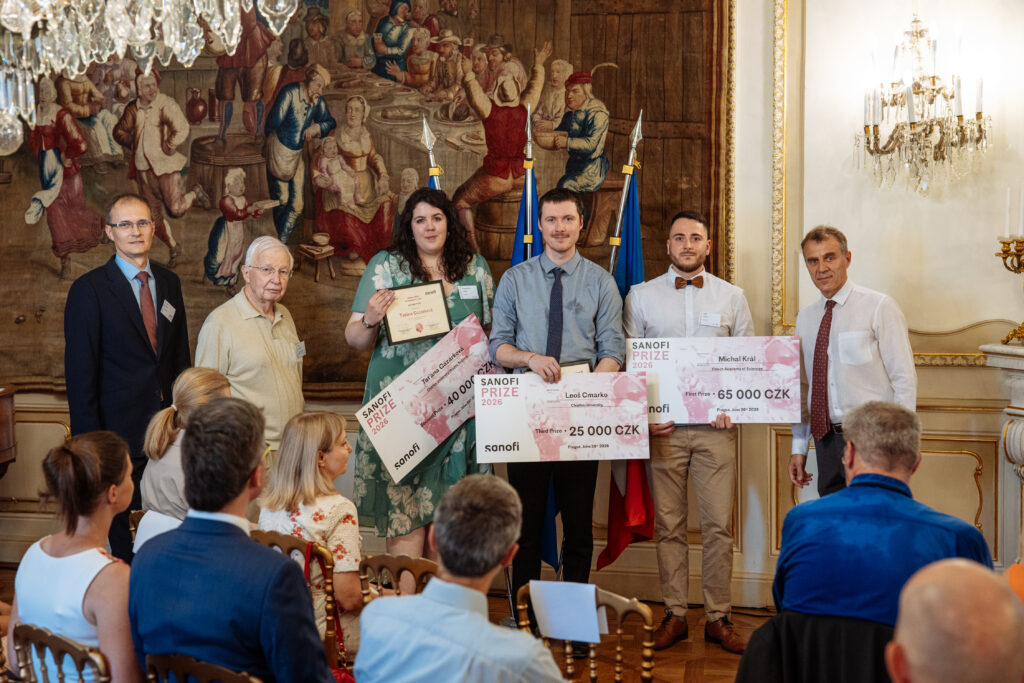
Photo: Sanofi Prize for Pharmacy 2026 (photo by Lukas Biba)

Please be advised that the IMIC CAS is changing its email addresses.
The new email address follows this format: “”
The original “@biomed.cas.cz” address on the website will be updated shortly.