21. 1. 2026


Bacteria of the genus Bordetella, which cause whooping cough and other respiratory diseases, actively bypass the respiratory tract’s defense mechanism. They do this using a special protein that “anchors” itself in the host’s cells. This unique mechanism was described by scientists from the Institute of Microbiology of the CAS in collaboration with colleagues from the University of California, Santa Barbara, in the journal Science.
Editor’s summary
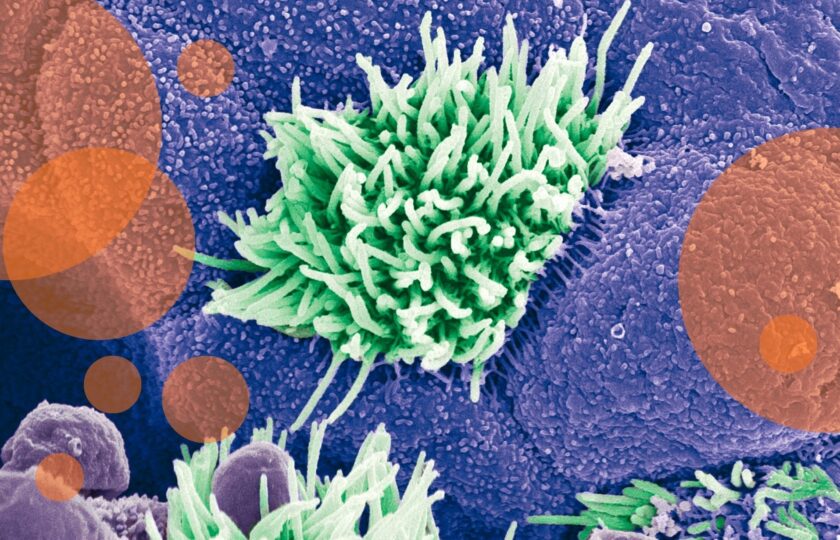
Bordetella bacteria infect the airways of animal hosts by sticking to tiny hair-like structures called cilia that line the respiratory tract. Costello et al. showed that these pathogens use a special adhesive protein that helps them attach to the host cell surface and that interacts with microtubules inside the cilia (see the Perspective by Jacob-Dubuisson). These interactions help the bacteria move from the tips of the cilia to the base. Bacteria in this basal niche are not swept away by normal airway cleaning mechanisms, explaining why Bordetella lacking this protein are unable to colonize the host respiratory tract effectively. (Stella M. Hurtley)
Abstract
Pathogenic Bordetella bacteria use protein adhesins to infect the ciliated respiratory epithelia of vertebrate hosts. In this work, we show that the filamentous hemagglutinin FhaB adhesin of Bordetella carries a C-terminal microtubule-binding domain (FhaB-CT), which is translocated into host cells to promote colonization. FhaB-CT delivery is required to occupy a niche at the base of cilia in airway epithelia, and mutant bacteria lacking this domain are defective for nasal colonization. These observations suggest that FhaB-CT is transferred into motile respiratory cilia to interact with core axonemal microtubules. We propose that Bordetella adheres initially to the tips of cilia and then deploys multiple FhaB adhesins to migrate to the base of the cilia forest, where the bacteria resist removal by the mucociliary “escalator” that normally clears the respiratory tract of microbes.
PUBLICATION
Bacteria deliver a microtubule-binding protein into mammalian cells to promote colonization. Science (2026). Costello et al.
Contact: dr. Ladislav Bumba
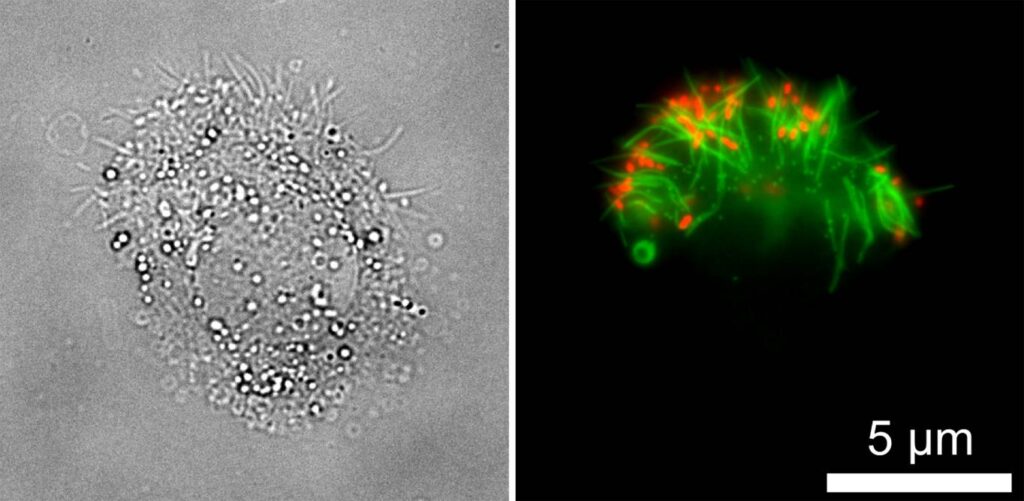
The infected ciliated cell in transmitted light (left) and fluorescence (right). Bacteria are marked in red, while green highlights the cilia. Source: Laboratory of Molecular Biology of Bacterial Pathogens, IMIC CAS.

Please be advised that the IMIC CAS is changing its email addresses.
The new email address follows this format: “”
The original “@biomed.cas.cz” address on the website will be updated shortly.