
Life is shaped by interactions, and one of them is the relationship between bacteria and their hosts. Our laboratory studies how Gram-negative pathogens use specialized secretion systems to manipulate the responses of their hosts and survive in different environments.
At the center of our research is the type III secretion system (T3SS), a bacterial apparatus resembling a syringe, also known as an injectisome. It is a sophisticated protein export machinery that enables the direct delivery of T3SS effector proteins from the bacterial cytosol into the host cell cytosol. The specific role of the T3SS in bacterial pathogenesis is determined by its expression and assembly, as well as by the repertoire of translocated effector proteins that manipulate host cell signaling pathways and defenses.
Ref. Kamanova, J.* (2020). Bordetella Type III Secretion Injectosome and Effector Proteins. Front. Cell. Infect. Microbiol. 04 Sept 2020, https://doi.org/10.3389/fcimb.2020.00466
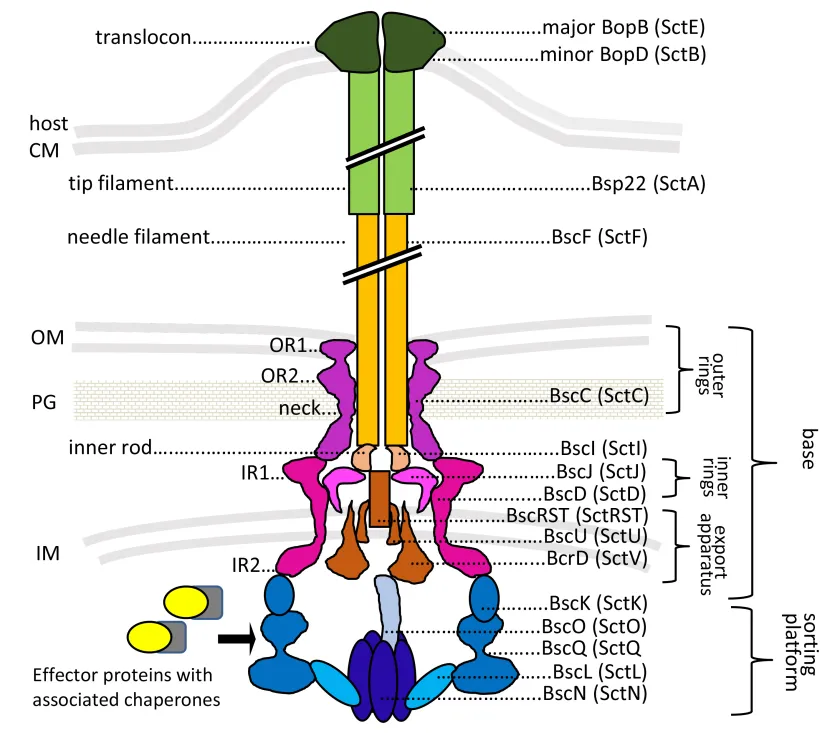
We focus on two model systems:
Bordetella pertussis and B. bronchiseptica, respiratory pathogens that colonize the airway epithelium. Their T3SS delivers the cytotoxic effector BteA and the gatekeeper BopN, both of which modulate host interaction. Our studies show that subtle sequence variations, such as an alanine insertion at position 503 in B. pertussis BteA, reduce cytotoxicity, likely reflecting evolutionary adaptation to the human host. We also investigate how host cues regulate T3SS activity, biofilm formation and persistence in the respiratory tract.
Aeromonas schubertii, an emerging aquatic pathogen and opportunistic pathogen in humans. We found that its virulence depends on a T3SS encoded within the Aeromonas Pathogenicity Island 1 (API1). This system delivers a unique repertoire of effectors, including conserved enzymes and previously undescribed proteins, which cooperate to orchestrate survival and host cell death. These results indicate how horizontal gene acquisition and effector diversity have enabled adaptation to aquatic hosts and environmental niches.
Our approach integrates structural and molecular biology, super-resolution and live-cell imaging with OMICs methodologies with the aim of linking molecular mechanisms to outcome of infection.